
Mukesh Ghimire, PhD
Energy and Climate Agenda in Major Political Parties’ Manifestos
Nepal’s electoral debates have traditionally revolved around governance, political stability, employment, and economic growth. Energy policy, when highlighted, often appeared through the symbolism of hydropower nationalism, while climate change was framed largely as an environmental obligation discussed more vigorously in global forums than domestic campaigns. That separation is now dissolving. Energy security shapes Nepal’s macroeconomic stability, trade balance, and industrial competitiveness, while climate change increasingly determines disaster risks, infrastructure resilience, agricultural productivity, and fiscal vulnerability. A close reading of the manifestos of the Nepali Congress (NC), Communist Party of Nepal–Unified Marxist Leninist (CPN-UML), Rastriya Swatantra Party (RSP), Nepali Communist Party (NCP), and Nepal Ujyalo Party (NUP) reveals a striking political shift. Clean energy, renewable expansion, electrification, green growth, climate resilience, and sustainability have moved to the center of political messaging. Yet beneath this convergence lies a familiar challenge: ambitions glorified in manifestos often outpace operational clarity, financing realism, and implementation credibility.
A. Energy Agenda: Big Targets, Bigger Questions
Hydropower Still Dominates the Political Imagination
Hydropower continues to anchor Nepal’s energy narrative across party platforms. Its enduring political appeal lies in Nepal’s abundant river systems, import substitution potential, and export prospects. The Nepali Congress and CPN-UML reaffirm hydropower expansion as a core economic strategy. NCP similarly places hydropower at the heart of its growth and structural transformation agenda. Nepal Ujyalo Party (NUP), known for its long-standing advocacy of energy-driven development, takes an even more ambitious stance by envisioning large-scale hydropower expansion—often projecting up to 40,000 MW in the long-term horizon (by 2100 BS)—positioning energy as the foundation of national prosperity. RSP, though less infrastructure-centric in tone, supports energy sector development through governance reforms and institutional efficiency.
However, differences emerge in framing emerging vulnerabilities. The Nepali Congress explicitly references climate-resilient hydropower, signaling recognition that Nepal’s hydrology is increasingly influenced by glacial retreat, erratic precipitation, sedimentation shifts, and extreme weather events. UML emphasizes expansion, utilization, and export orientation, while climate adaptation integration appears less explicitly articulated. NCP underscores rapid capacity growth, focusing on scale and execution. NUP stresses transformative expansion, export dominance, and energy sovereignty. RSP’s emphasis remains indirect, anchored in governance credibility rather than sectoral engineering detail.
The divergence is subtle but consequential. Hydropower expansion without climate-risk integration risks exposing Nepal to long-term technical, operational, and financial stress.
Numerical Capacity Targets: A New Manifesto Trend
Unlike earlier election cycles characterized by generalized aspirations, recent manifestos increasingly include quantitative generation targets. Congress and UML propose raising Nepal’s installed capacity to roughly 14,000 MW within five years. NCP’s targets suggest expansion approaching 15,000 MW within a similar timeframe. Nepal Ujyalo Party articulates the most ambitious long-term projection, targeting 40,000 MW in the coming decades, emphasizing Nepal as a regional energy powerhouse. RSP-linked narratives refer to higher long-term aspirations but frame them as directional rather than fixed commitments.
These targets signal political acknowledgment that Nepal’s economic transformation requires abundant electricity supply. Yet targets alone do not ensure outcomes. Installed capacity expansion must be synchronized with transmission infrastructure, grid modernization, storage integration, market development, and financing mechanisms. Megawatts without markets risk underutilization.
Domestic Consumption: An Emerging Consensus
A notable area of convergence across manifestos is the focus on per-capita electricity consumption, with several parties referencing a benchmark of approximately 750 kilowatt-hours within five years. This reflects growing awareness that Nepal’s energy future cannot depend solely on exports; domestic demand deepening is essential for sustainable sector growth.
Higher domestic consumption underpins industrial electrification, agro-processing, rural enterprise development, clean cooking transitions, digital services, and urban energy productivity. Electricity must power internal economic transformation—not merely generate surplus for cross-border trade.
Yet manifestos rarely articulate detailed policy instruments to stimulate demand growth. Consumption expansion depends on affordability, reliability, appliance access, tariff design, behavioral adoption, and distribution system readiness. Demand growth requires more than supply growth.
Electrification and Clean Cooking
Electrification of cooking and mobility features prominently in Congress’ manifesto, which explicitly promotes electric stoves and electric vehicles. UML’s emphasis on domestic consumption implicitly supports electrification pathways. NCP links electrification with industrialization and economic restructuring. Nepal Ujyalo Party frames electrification as a national modernization agenda and energy sovereignty strategy. RSP does not foreground electrification technically but supports enabling governance conditions.
Electrification promises multiple benefits: reduced LPG imports, improved air quality, lower emissions, and strengthened electricity demand. However, operational challenges remain under-examined. Grid reliability, voltage stability, transformer capacity, appliance affordability, and consumer financing are decisive determinants of adoption success.
Electrification is both an infrastructure and socio-economic transition.
Energy Export and Regional Diplomacy
Energy exports feature prominently in UML, NCP, and NUP manifestos, where export revenues are linked with prosperity and national strength. Congress balances export ambitions with domestic utilization. RSP’s governance-centered framing indirectly supports stable energy trade conditions.
Nepal’s export potential depends on sustained diplomatic engagement, cross-border transmission capacity, predictable regulatory frameworks, pricing competitiveness, and long-term bilateral agreements. Export optimism without secured market access risks creating unrealistic fiscal expectations.
Exports are negotiated outcomes, not political declarations.
Governance: The Decisive Constraint
Governance reform emerges as the most critical cross-cutting theme. RSP places governance integrity, transparency, and efficiency at the center of its manifesto. Congress implies institutional strengthening through structural reform language. UML stresses delivery effectiveness. NCP emphasizes accelerated project execution. NUP calls for streamlined approvals and strategic coordination to unlock large-scale investment.
Nepal’s historical energy sector challenges—project delays, transmission bottlenecks, procurement inefficiencies, regulatory uncertainty, and coordination fragmentation—underscore that governance failures remain the principal constraint on delivery.
Energy transition success is fundamentally institutional.
B. Climate Agenda: Recognition Without Full Operationalization
Climate Change as National Development Reality
Climate change now features visibly across party manifestos. Congress integrates climate considerations with renewable energy expansion, forest conservation, pollution control, and climate finance mobilization. UML references green development, climate diplomacy, and disaster preparedness. NCP links climate discourse with resource management and resilience. RSP foregrounds disaster risk reduction and institutional credibility. Nepal Ujyalo Party supports renewable energy expansion and low-carbon development but places stronger emphasis on energy-led growth than on detailed climate adaptation frameworks.
This shift reflects Nepal’s lived experience of intensifying floods, landslides, glacier-related hazards, and weather variability. Climate is no longer peripheral.
Adaptation, Resilience and Net-Zero Narratives
Congress explicitly aligns reforms with Nepal’s net-zero emissions ambition by 2045. UML emphasizes green growth and sustainability. NCP frames development within sustainable transformation. RSP supports climate responsibility through governance reforms. NUP emphasizes clean energy dominance but articulates fewer detailed adaptation mechanisms.
Adaptation represents Nepal’s most immediate climate necessity. Yet across manifestos, detailed adaptation financing frameworks, measurable benchmarks, and sectoral prioritization strategies remain limited. Resilience language must translate into resilient investment.
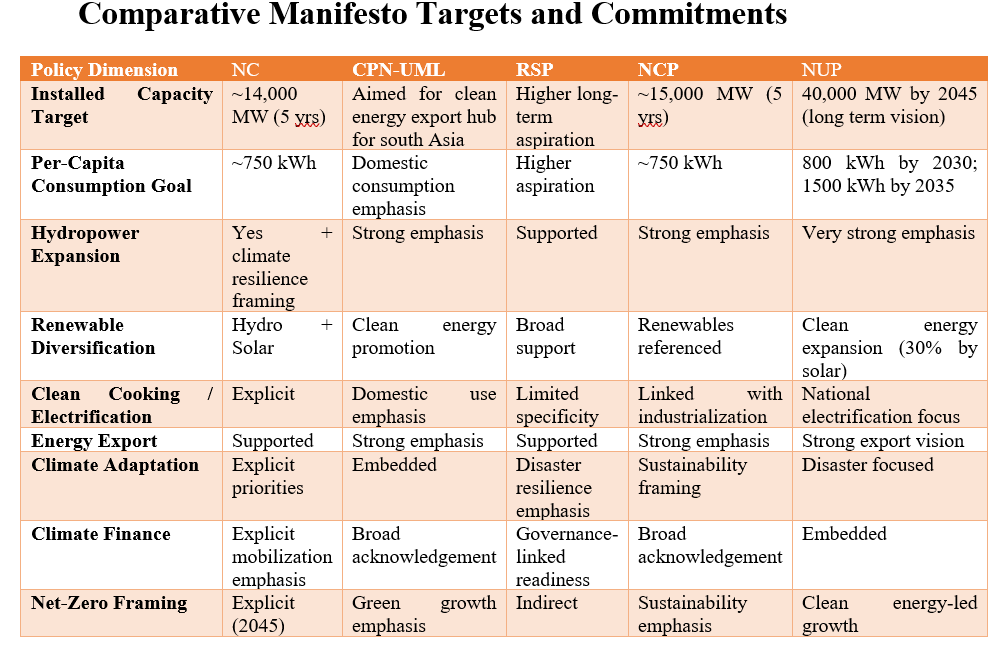
Comparative Manifesto Targets and Commitments
| Policy Dimension | NC | CPN-UML | RSP | NCP | NUP |
| Installed Capacity Target | ~14,000 MW (5 yrs) | Aimed for clean energy export hub for south Asia | Higher long-term aspiration | ~15,000 MW (5 yrs) | 40,000 MW by 2045 (long term vision) |
| Per-Capita Consumption Goal | ~750 kWh | Domestic consumption emphasis | Higher aspiration | ~750 kWh | 800 kWh by 2030; 1500 kWh by 2035 |
| Hydropower Expansion | Yes + climate resilience framing | Strong emphasis | Supported | Strong emphasis | Very strong emphasis |
| Renewable Diversification | Hydro + Solar | Clean energy promotion | Broad support | Renewables referenced | Clean energy expansion (30% by solar) |
| Clean Cooking / Electrification | Explicit | Domestic use emphasis | Limited specificity | Linked with industrialization | National electrification focus |
| Energy Export | Supported | Strong emphasis | Supported | Strong emphasis | Strong export vision |
| Climate Adaptation | Explicit priorities | Embedded | Disaster resilience emphasis | Sustainability framing | Disaster focused |
| Climate Finance | Explicit mobilization emphasis | Broad acknowledgement | Governance-linked readiness | Broad acknowledgement | Embedded |
| Net-Zero Framing | Explicit (2045) | Green growth emphasis | Indirect | Sustainability emphasis | Clean energy-led growth |
From Shared Rhetoric to Measurable Results
Nepal’s major political parties now clearly recognize that energy security and the climate agenda are inseparable from the country’s development future. Installed capacity targets, consumption benchmarks, renewable diversification, electrification strategies, and climate commitments reflect a welcome maturation of political discourse. However, the real test lies not in the scale of promises but in the credibility of execution. The defining question is no longer which party pledges more megawatts or a bolder green vision, but which leadership can deliver bankable projects, reliable and affordable electricity, climate-resilient infrastructure, predictable regulation, transparent governance, and tangible benefits for citizens. Nepal’s past experience of policy discontinuity and implementation delays underscores that ambition without delivery risks deepening public skepticism. Ultimately, Nepal’s sustainable future will be shaped not by manifesto rhetoric but by consistent policy performance and measurable results.
Note: The author’s opinion expressed in this article is personal, not related to the author’s affiliated organization.