“From Ukraine to the Strait of Hormuz, geopolitical tensions are reshaping global energy supply chains—driving price volatility and exposing the vulnerability of oil-importing economies such as Nepal. A war in Eastern Europe, a tanker threat in the Persian Gulf, or an attack on a distant shipping route can raise fuel prices overnight—reminding the world that energy markets are ultimately governed not just by economics, but by geopolitics.”
Mukesh Ghimire, PhD
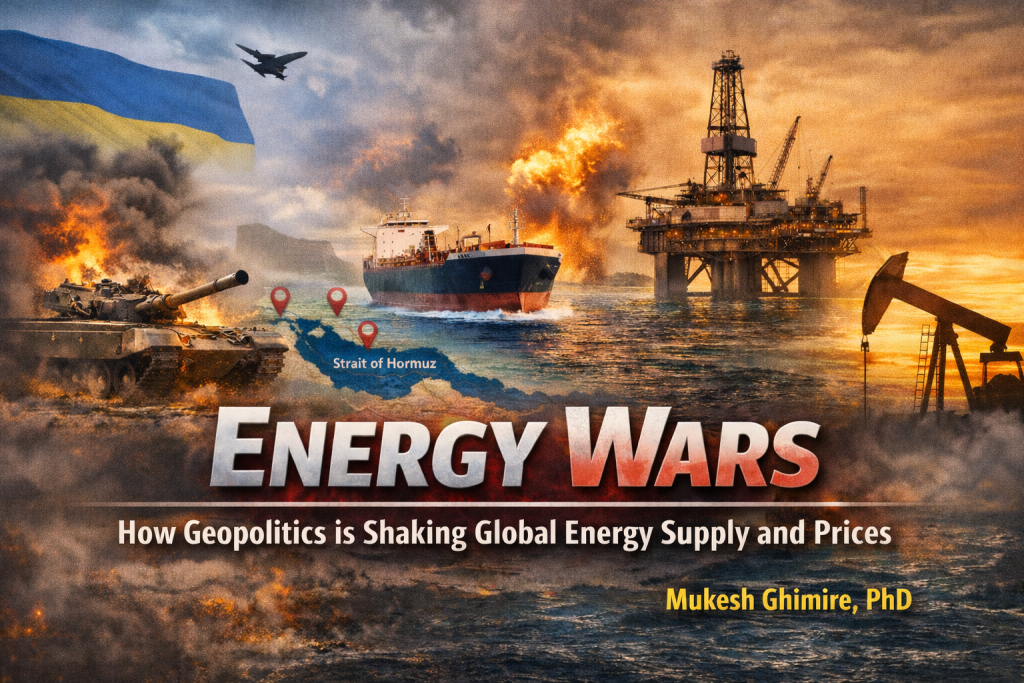
Energy has never been merely a commodity. It is a strategic resource deeply embedded in global politics, economic stability, and national security. In theory, energy prices should respond primarily to supply and demand. In reality, however, the global energy system is shaped just as strongly by wars, sanctions, diplomatic rivalries, and conflicts around key transportation routes.
The past decade has provided repeated reminders of this reality. From the Russia–Ukraine war to escalating tensions in the Middle East and disruptions along global shipping routes, geopolitical events have repeatedly shaken energy supply chains and triggered price shocks across the world. These crises demonstrate a fundamental truth: the global energy system remains fragile, highly interconnected, and vulnerable to political turbulence.
For countries heavily dependent on imported fossil fuels, the consequences can be severe. Rising global oil prices quickly translate into higher transportation costs, inflationary pressure, and economic uncertainty. Nepal, despite remarkable progress in expanding renewable hydropower and electricity access, remains heavily dependent on imported petroleum products. As a result, geopolitical conflicts occurring thousands of kilometers away can have immediate impacts on Nepal’s economy.
Major Geopolitical Events Affecting Energy Markets
| Geopolitical Event | Period | Estimated Supply Impact | Oil/Gas Price Spike |
| Russia–Ukraine War | 2022–present | ~3–4 million barrels/day disrupted in European markets | Brent oil surged from ~$75 to ~$130 per barrel |
| U.S.–Iran tensions and Hormuz threats | Recurrent 2019; 2026 | Up to 20% of global oil flows at risk | Market risk premium adds $10–$20 per barrel |
| Israel–Hamas and broader Middle East tensions | 2023–present | Regional export routes affecting ~6–8 mb/d under risk | Brent jumped above $95 |
| Red Sea shipping crisis | 2024–present | Tankers rerouted; shipping capacity tightened by ~10–15% | Freight costs increased up to 40% |
| OPEC+ coordinated production cuts | 2023–2024 | ~2–3 million barrels/day removed from market | Brent oil stabilized near $90 |
| Sanctions on Russia, Iran, Venezuela | 2018–present | Restricted ~5–7 mb/d traditional supply channels | Global oil price volatility increased |
| U.S.–China strategic rivalry | Ongoing | Disruptions in critical minerals & energy technologies | Clean energy component prices increased |
| Pipeline sabotage (Nord Stream etc.) | 2022 | Major gas infrastructure destroyed | European gas prices surged >300% |
| Global LNG competition (Europe vs Asia) | 2022–present | LNG diverted to Europe; Asian supply tightened | LNG prices rose above $40/MMBtu |
| Threats to maritime chokepoints (Hormuz, Suez, Malacca) | Ongoing | Up to 30% of global oil trade exposed to disruption | Global price volatility spikes |
Wars That Reshape Energy Markets
Modern conflicts often begin as regional political crises but quickly transform into global economic shocks. The Russia–Ukraine war in 2022 demonstrated this dynamic vividly. Prior to the conflict, Russia was one of the world’s largest exporters of oil and natural gas and supplied nearly 40 percent of Europe’s gas demand. When sanctions were imposed, and pipeline flows were curtailed, the global energy system experienced its most severe disruption in decades.
Gas prices in Europe surged to record levels, electricity markets became unstable, and oil prices briefly climbed above $130 per barrel. Governments across Europe rushed to secure alternative supplies, dramatically increasing imports of liquefied natural gas (LNG) from the United States and Qatar. The sudden shift in energy flows tightened global LNG markets, pushing prices upward in Asia as well.
The war illustrated how deeply interconnected the global energy system has become. A conflict in Eastern Europe rapidly affected energy prices across continents, reinforcing the strategic importance of diversification and energy resilience.
The Middle East presents a similar risk. The region holds more than half of the world’s proven oil reserves, making it central to global energy security. Yet it is also one of the most geopolitically volatile regions. Drone attacks on oil facilities, proxy conflicts, and regional rivalries have repeatedly threatened production infrastructure and export terminals. When tensions rise in the region, markets respond immediately.
Strategic Chokepoints and the Geography of Energy
Energy security is not determined only by how much oil or gas is produced. It also depends on the routes through which energy flows.
Global oil and gas trade rely heavily on several narrow maritime corridors known as strategic chokepoints. Among these, the Strait of Hormuz remains the most critical. Nearly one-fifth of global oil shipments pass through this narrow waterway between Iran and Oman. Any disruption—whether through military confrontation or shipping blockades—would send immediate shockwaves through global energy markets.
Other chokepoints, including the Suez Canal, Bab el-Mandeb Strait, and the Strait of Malacca, also play vital roles in transporting energy supplies between continents. Recent attacks on commercial vessels in the Red Sea have demonstrated how vulnerable these routes are. Oil tankers forced to reroute around the Cape of Good Hope must travel thousands of additional kilometers, increasing fuel consumption, insurance costs, and delivery times.
These disruptions highlight a crucial reality: global energy systems depend not only on production but also on secure transportation networks. When shipping routes become unstable, the effects quickly appear in global fuel prices.
Sanctions, Rivalries, and a Fragmented Energy System
Geopolitics now shapes energy markets not only through war but also through economic sanctions and strategic rivalries. Over the past decade, sanctions targeting major oil producers—including Russia, Iran, and Venezuela—have significantly reshaped global trade patterns. In response, these countries have developed alternative export arrangements involving discounted oil, informal shipping networks, and new trading partnerships. Oil that once flowed through transparent markets now moves through complex networks of intermediaries and shadow fleets. The result is a more fragmented global energy system. Supply chains have become less predictable, price volatility has increased, and geopolitical alliances increasingly influence energy trade.
At the same time, strategic competition between major powers—particularly the United States and China—is reshaping the future of energy technologies. Critical minerals such as lithium, cobalt, and rare earth elements have become central to geopolitical competition because they are essential for renewable energy systems, electric vehicles, and battery manufacturing. Thus, geopolitics now shapes not only fossil fuel markets but also the emerging clean energy economy.
Nepal’s Energy Security in a Geopolitical World
For Nepal, global energy geopolitics is not a distant concern. It has direct implications for economic stability and development planning.
Despite significant progress in hydropower development and electricity access, Nepal remains heavily dependent on imported petroleum fuels. Diesel, petrol, aviation fuel, and liquefied petroleum gas constitute a large share of the country’s import bill each year.
Although these fuels are imported primarily through India, their prices are ultimately determined by global crude oil markets. When international oil prices surge due to geopolitical tensions, the effects are quickly felt across Nepal’s economy. Transportation costs rise, inflation increases, and pressure mounts on foreign exchange reserves. Fuel imports also contribute significantly to Nepal’s trade deficit. This structural dependence makes the country particularly vulnerable to global energy price shocks.
While most global energy shocks originate from major geopolitical conflicts or disruptions in maritime trade routes, regional political tensions can also have profound consequences. Nepal experienced this directly during the 2015–2016 India border blockade, when fuel imports were severely restricted, leading to acute shortages of petroleum products across the country. Transportation halted, industries slowed, and daily life was disrupted—demonstrating how vulnerable landlocked economies can be to geopolitical pressures in energy supply chains. The long-term solution lies in reducing reliance on imported fossil fuels. Nepal’s abundant hydropower and other renewable resources provide a unique opportunity to build a more resilient and domestically driven energy system. Expanding electric mobility, green energy transition in industries, promoting electric cooking technologies, and investing in decentralized renewable energy solutions can significantly reduce oil consumption. Such measures would not only support climate goals but also strengthen economic resilience.
Demand and Supply Response to Energy Shocks: From “Half Gas Cylinders” to Electric Cooking
In response to recent energy supply pressures, Nepal has explored a practical emergency demand-management measure—the temporary distribution of “half gas cylinders.” Instead of distributing the standard 14.2 kg LPG cylinder, households could receive half-filled cylinders during periods of supply disruption or severe import constraints. Such an approach allows limited LPG supplies to be shared among more households, reducing the risk of acute shortages in urban areas and ensuring that basic cooking energy remains accessible during crises. Similar demand-management measures—including rationing or temporary consumption limits—have been used globally during fuel shortages. However, the need for such measures also reveals a deeper structural challenge: Nepal’s continued dependence on imported LPG for household cooking. While a “half cylinder” policy may help stabilize supply during emergencies triggered by geopolitical shocks or border disruptions, it cannot address the underlying vulnerability.
The more durable solution lies in accelerating electric cooking powered by Nepal’s growing renewable power generation. Promoting induction stoves and other efficient electric appliances can gradually replace LPG imports while utilizing domestic electricity. In essence, emergency tools like half-filled cylinders help manage short-term supply shocks, while electric cooking represents the long-term path to energy security. After all, every LPG cylinder imported into Nepal sends foreign currency abroad, while every electric stove powered by hydropower keeps that energy value within the national economy.
Energy Transition as Strategic Policy
The past decade has shown that energy markets are increasingly shaped by geopolitics. Wars, sanctions, maritime conflicts, and strategic rivalries now influence global energy prices as much as traditional supply-and-demand dynamics. For countries dependent on imported fossil fuels, the lesson is clear: energy security cannot rely solely on global supply chains vulnerable to geopolitical disruption. Instead, resilience must come from diversification, domestic energy resources, and accelerated adoption of renewable technologies.
For Nepal, the transition toward electrified transport, clean cooking, and renewable energy is not merely part of a climate agenda. It is a strategic economic imperative. In an era of geopolitical uncertainty, the countries that build secure, diversified, and domestically powered energy systems will be best prepared for the next global shock. Nepal has the resources to make that transition—what remains is the urgency to accelerate it.
Note: Mukesh Ghimire, PhD, currently holds the position of Director at the Alternative Energy Promotion Centre (AEPC), under the Ministry of Energy, Water Resources and Irrigation, Government of Nepal. The views expressed in this article are the author’s own and do not represent those of the organization.